Middle School STEM (Science, Technology, Engineering, & Mathematics)
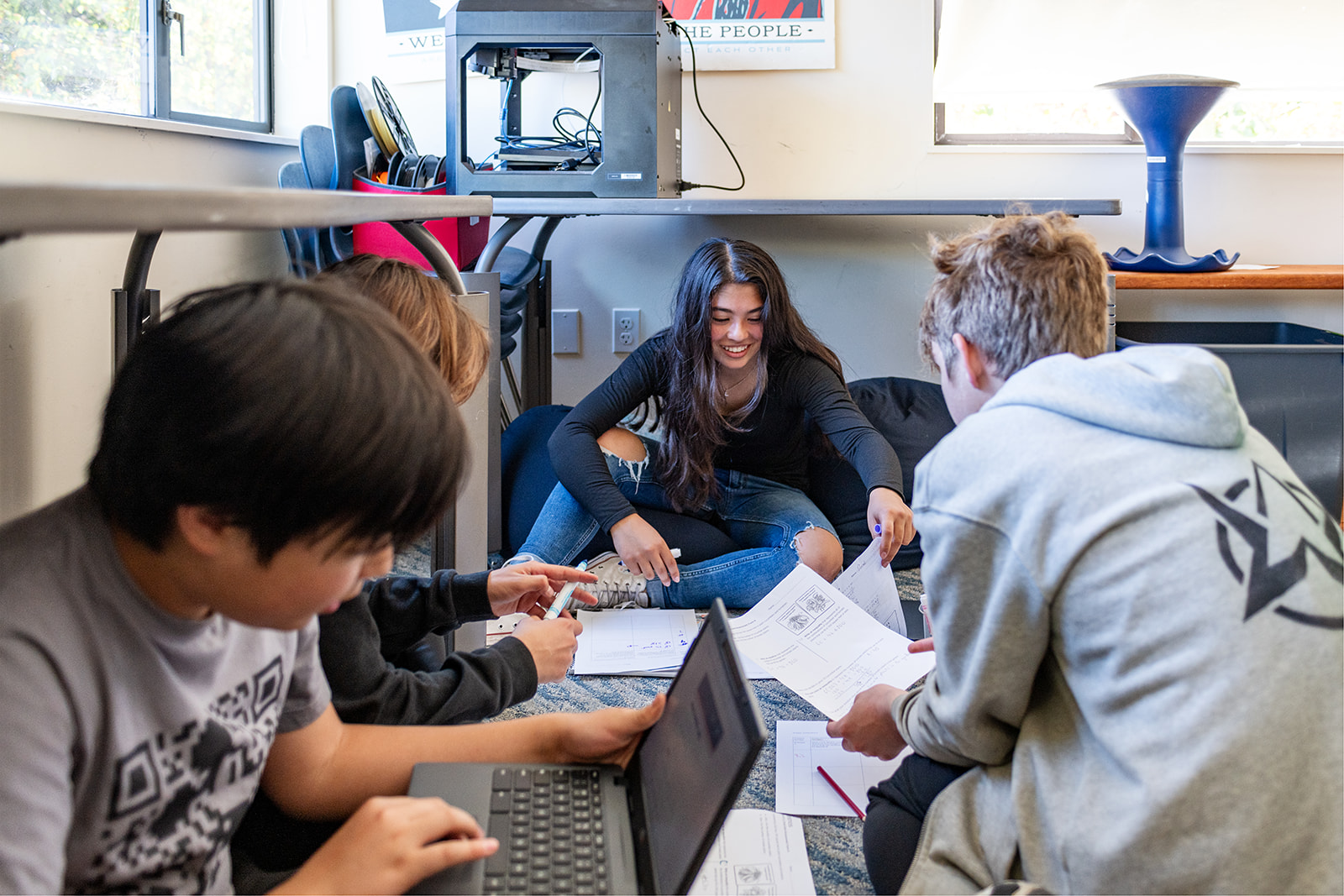
Our Middle School STEM program invites students to “figure out” rather than “learn about,” challenging them to engage with concepts through inquiry, experimentation, and discussion. Students build scientific literacy by asking questions, testing hypotheses, using the tools and technologies available in our Maker Space, and connecting science to their everyday lives. A three-year integrated science curriculum, aligned with Next Generation Science Standards, ensures that every student graduates with the conceptual and content knowledge necessary to succeed in high-school science classes.
TK-8 Visual Arts
Our visual arts program develops students’ vocabulary, technical skills, and creative thinking. Through projects that explore 2D and 3D design, color theory, and sculpture, students learn to express complex ideas and connect art to culture and social change. Curriculum adapts to community events and local museum exhibits, and visiting artists provide hands-on workshops. Students build confidence, critical thinking, and a lifelong appreciation for contemporary art while developing practical skills to bring their ideas to life.
TK-8th Spanish
Whether heritage speakers or beginners, students are challenged at the right level to grow their Spanish skills. Through song, movement, art, poetry, games, reading, and writing, they build comfort and confidence in listening and speaking. Students expand vocabulary through gestures, storytelling, and interactive practice, while also encountering Spanish beyond the classroom to boost fluency. Our program weaves Latinx cultural studies into literacy, art, music, and more—sparking curiosity and a love of both language and culture
TK-8th Music
Our Orff-based music program sparks joy through rhythm, movement, and storytelling. Students explore percussion and mallet instruments, play in ensembles, and act out stories with sound and movement. They also experience music from around the world, including Afro-Caribbean and African rhythms, building creativity, confidence, coordination, and an appreciation for diverse musical traditions
TK-8th PE
Our PE program builds both physical skills and a love of movement. Students develop locomotor, stability, and manipulative skills while learning body mechanics, spatial awareness, and effort control. Just as importantly, they practice teamwork—listening, cooperating, and sharing—and sportsmanship—honesty, fairness, and respect in both winning and losing. With these foundations, students strengthen social-emotional skills and learn what it means to be a good teammate and classmate.
TK-8th Cultural/Civic Studies
Our Cultural Studies program helps students explore identity, gender, and cultural diversity through an anti-bias framework. Younger students learn to value differences and see themselves as changemakers, while older students connect history to current events to understand the ways that humans identify challenges, make decisions, and implement solutions that impact communities in both negative and positive ways. Across all grades, students build empathy, critical thinking, and a sense of responsibility as local and global citizens.
TK-8th Health
At TBS, Health class helps students develop the social and emotional skills they need to thrive as individuals, friends, and community members. Young students explore feelings, empathy, and self-regulation through the Zones of Regulation, learning to express themselves with “I” statements and read non-verbal cues. As they grow, students practice active listening, self-coaching, and assertive communication, building a growth mindset and the ability to engage thoughtfully with others.